
Specialist Installers and Suppliers of
Monitored CCTV
Most security failures don’t happen in broad daylight. They happen at 3am, in fog, on a site with no working floodlight, where a standard camera is producing nothing more than a grey rectangle on a monitor. That’s the operating gap thermal security cameras exist to close.
A thermal security camera reads heat instead of light, which means it keeps producing a usable image in total darkness, heavy fog, smoke, or driving rain, conditions where standard CCTV genuinely struggles. For construction sites, industrial yards, and high-risk infrastructure across Leeds and West Yorkshire, that difference often decides whether an intrusion gets caught at the perimeter or discovered the next morning.
This guide covers how thermal detection actually works, where it earns its place on a site, and how it fits alongside the rest of a security setup. For site-specific pricing and a full breakdown of available hardware, see our Thermal Security Camera service.
A thermal security camera detects the heat energy radiating from people, vehicles, and objects, rather than capturing reflected visible light the way a standard camera does. Every object above absolute zero gives off infrared radiation, and a thermal sensor converts those temperature differences directly into an image.
This is the key distinction from conventional CCTV. A standard camera needs enough ambient or artificial light to form a picture. A thermal camera doesn’t need any light source at all. It produces a clear, high-contrast image purely from temperature data, which is why a person crossing a completely unlit yard still shows up as a bright, well-defined shape against a cooler background.
That single property is what makes thermal hardware useful for perimeter security cameras and facility monitoring solutions on sites where lighting is limited, expensive to install, or simply impractical.
The process behind a thermal image is consistent regardless of the site it’s deployed on. Specialised germanium lenses, the only practical material for focusing infrared radiation, direct heat energy onto a microbolometer sensor array inside the unit. That sensor array converts minute temperature differences into a digital video feed in real time.
Because this entire conversion happens within the sensor itself, it sidesteps the environmental problems that genuinely limit optical systems: blinding glare from low winter sun, drifting smoke, or a complete absence of ambient light.
Microbolometers register tiny temperature changes without requiring artificial cooling systems, a detail that matters more in practice than it sounds. Uncooled sensors keep the hardware low-maintenance and able to run continuously, day and night, without scheduled servicing of a cooling unit. For industrial sites running heat detection systems around the clock, this is what keeps the hardware operational without constant intervention.
Traditional night vision cameras rely on active infrared illumination or amplifying whatever ambient light is available. Both methods share a weakness: point a torch, a phone screen, or a set of headlights directly at the lens, and the image washes out or blinds entirely.
Pure heat detection doesn’t carry that vulnerability. A thermal feed keeps reading temperature regardless of what’s pointed at it, which is a meaningful advantage over motion detection cameras and standard CCTV installation that depend on light in some form.
Thermal hardware isn’t the right fit for every site, but the ones that benefit most tend to share a pattern: large boundaries, restricted visibility, or zero-light operating conditions where monitoring has to run continuously.
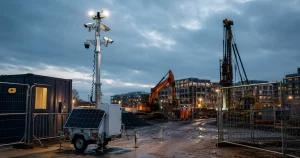
Unlit, sprawling, and full of valuable plant and materials overnight, construction sites are exactly the environment thermal cameras were built for. They detect heat signatures from people and vehicles entering the perimeter without relying on floodlighting, which makes them a natural pairing with a Rapid Deployment Tower on sites with no fixed power infrastructure at all.
Inside the perimeter, the risk changes shape. Machinery, substations, and storage compounds carry a different kind of threat: a temperature rise that signals a fire risk or mechanical fault long before any visible smoke appears. An early heat alert here can turn a site emergency into a scheduled maintenance call, often hours ahead of a problem becoming visible to the naked eye.
Rural sites, unmanned substations, and vacant or unused buildings frequently have limited or no lighting, which makes standard CCTV considerably less effective after dark. Thermal cameras need no light source to work, making them a practical fit for vacant property security where ongoing lighting costs and maintenance aren’t an option.
The case for thermal hardware isn’t really about image quality. It’s about what the technology removes from day-to-day operating costs.
A professional deployment follows a fixed sequence, and understanding each phase helps set realistic expectations for how long it takes to get a system live.
Engineers assess the site to identify structural obstacles, map boundary lines, and locate blind spots before any hardware goes up. This stage also confirms camera positioning won’t create a regulatory privacy overlap with neighbouring properties.
Target distance dictates lens choice. A unit specified for basic motion detection at short range is a different piece of hardware from one capable of classifying a human target against a vehicle at several hundred metres, so getting this right at the specification stage matters more than it might seem.
Mounting matters just as much. West Yorkshire weather is not gentle on exposed hardware, and even minor pole vibration in high wind can distort a long-range thermal image. Heavy-duty brackets and properly rated enclosures are what keep the system producing usable data through a Yorkshire winter rather than failing at the first storm.
Once hardware is mounted, engineers configure power and network routing, then move into analytics tuning: setting detection zones, adjusting temperature baseline thresholds, and running live walk-tests to confirm alert delivery speeds before handover.
Thermal hardware isn’t a replacement for every camera on a site, and a properly balanced setup usually runs more than one technology side by side. Thermal sensors are the better choice for early detection in low or no light, but once an alert is live, high-definition optical coverage remains necessary for colour verification and identification.
This is also where wider analytics come in. PAP’s Intelligent Video Analytics can sit alongside thermal hardware to distinguish people, vehicles, and animals automatically, reducing the number of alerts that actually need a human response. A site running both thermal detection and multi-angle HD coverage gets early warning from heat data and visual confirmation the moment something needs a closer look.
No. Thermal sensors read surface temperature, not what’s behind it. A camera pointed at a wall or window registers the surface heat of that material, not anything on the other side. Detection still depends on a clear sightline, the same as any visual system, it just doesn’t need light to work.
Severe moisture in the air can shorten a thermal unit’s effective range to some degree, since water droplets scatter infrared radiation. Even so, thermal contrast holds up far better than optical sightlines during winter weather, where fog and low light typically cause much larger drops in visibility.
No. That’s the core advantage over optical systems. Thermal hardware runs at full efficiency in total darkness without floodlights or infrared illuminators, which makes it well suited to sites with no existing lighting infrastructure.




Whether you need CCTV, manned guarding, mobile patrols, access control, or alarm response, our experienced team is here to help. Get expert advice and a free, no-obligation quote tailored to your security requirements.

We use cookies to improve your experience, analyse website traffic, and store preferences. You can accept or manage cookies anytime through your browser settings.
Manage your cookie preferences below:
Essential cookies enable basic functions and are necessary for the proper function of the website.
These cookies are needed for adding comments on this website.
Statistics cookies collect information anonymously. This information helps us understand how visitors use our website.
Google Analytics is a powerful tool that tracks and analyzes website traffic for informed marketing decisions.
Service URL: policies.google.com (opens in a new window)
Clarity is a web analytics service that tracks and reports website traffic.
Service URL: clarity.microsoft.com (opens in a new window)