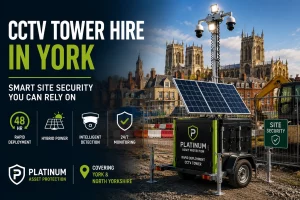
Specialist Installers and Suppliers of
Monitored CCTV
A mobile CCTV tower is a self-contained, portable surveillance unit built for sites where permanent infrastructure isn’t an option. Construction, infrastructure, events, and vacant property sectors all rely on CCTV towers to maintain security without the delays of fixed installation. Unlike traditional systems, mobile surveillance towers are operational within hours — giving teams the flexibility of a rapid deployment CCTV tower that moves as risks change on-site. For businesses that need robust, scalable surveillance solutions without a long-term commitment, mobile towers are the clear choice.
A mobile CCTV tower is a fully self-contained surveillance unit that requires no fixed infrastructure to operate. Everything needed to monitor, record, and transmit footage is built into a single deployable unit making it ideal for any temporary or remote location that needs immediate protection.
At its core, a mobile tower combines several key components working together. A telescopic mast elevates PTZ cameras to an optimal height, providing wide-area coverage across large or complex sites. Onboard power systems solar panels, batteries, or mains connection, keep the unit running continuously, while built-in 4G or Wi-Fi connectivity enables live remote monitoring from anywhere in the world.
Whether deployed as a standalone site CCTV tower or as part of a wider network of surveillance trailers, each unit operates independently no cabling runs, no groundworks, no reliance on existing site infrastructure. Combined with mobile surveillance capabilities that allow relocation in hours, it’s a security solution that adapts to your site rather than the other way around.
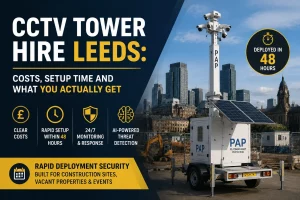
A rapid deployment CCTV tower is designed to go from delivery to live monitoring in a matter of hours no engineers, no groundworks, no lengthy installation process. For sites where security risks can emerge overnight, that speed is everything.
Most rapid deployment towers arrive ready to operate straight off the vehicle. Once positioned on-site, the telescopic mast is raised, cameras are angled to cover key areas, and the onboard power system whether solar, battery, or mains is activated. The entire setup process typically takes under two hours, making it one of the fastest security deployments available for any site type.
One of the biggest advantages of mobile surveillance towers is their ability to operate completely off-grid. Solar panels combined with high-capacity battery banks keep units running 24/7 without any connection to mains power, critical for remote construction sites, rural infrastructure projects, or any location where power supply is limited or unreliable.
Once live, operators can access camera feeds remotely via 4G or Wi-Fi connectivity from any device, anywhere in the world. This means a rapid deployment tower doesn’t just protect a site physically, it connects your security team to real-time footage the moment installation is complete, enabling immediate incident detection and rapid response when it matters most.
Modern sites are complex, constantly changing environments — and a mobile CCTV tower is built to keep up with them. Whether a site expands, shifts focus, or faces new risks overnight, static security infrastructure simply can’t respond fast enough. Mobile surveillance fills that gap, delivering consistent coverage exactly where and when it’s needed.
Construction sites are among the highest-risk environments for theft, vandalism, and unauthorised access. Large perimeters, multiple access points, and constantly evolving layouts make it almost impossible for fixed cameras to maintain full coverage throughout a project’s lifecycle. Construction site theft costs UK businesses an estimated £800 million per year, with plant, materials, and cable among the most frequently targeted assets. Infrastructure projects face similar challenges — often operating across remote or roadside locations where permanent CCTV installation isn’t feasible.
Vacant properties are particularly vulnerable during periods between occupancy, when the absence of activity makes them a target. A site CCTV tower provides a visible deterrent and continuous monitoring without requiring any modifications to the building or grounds. For events, where crowd movement and layout change daily, mobile units can be repositioned overnight to adapt to shifting security demands.
Blind spots are one of the most exploited weaknesses in any security setup. Mobile surveillance systems eliminate them by allowing precise camera positioning at height, covering wide areas that fixed infrastructure would struggle to reach. Paired with remote monitoring, these surveillance solutions don’t just capture incidents — they enable security teams to respond in real time, reducing the window between detection and intervention significantly.
Not all CCTV towers are built the same. Before committing to a purchase or mobile CCTV tower hire, these are the key features worth evaluating:
Choosing the right mobile surveillance system comes down to matching these features against the specific demands of your site — coverage area, duration, power availability, and monitoring requirements all play a role in finding the right fit.
Not every mobile CCTV tower is built to the same standard. Professional-grade units are engineered for reliability, performance, and long-term deployment and the gap between a well-specified system and a low-spec alternative becomes very clear the moment an incident occurs. These are the nine features that define effective CCTV towers and separate serious surveillance solutions from systems that simply look the part.
Security demands on temporary sites rarely stay the same from one week to the next. A rapid deployment CCTV tower is specifically designed to respond to that reality but the value of rapid deployment goes beyond speed of setup. It’s about what that speed enables operationally: the ability to protect a site the same day a threat materialises, and to move that protection as the threat evolves.
For site managers, every hour without security coverage is a period of exposure. A rapid deployment tower eliminates that exposure window entirely. Units require no groundworks, no specialist installation, and are typically live within two hours of delivery. For emergency situations, a break-in, an escalating dispute, or a sudden change in site layout that response speed can be the difference between preventing an incident and simply recording one after the fact.
What sets mobile surveillance towers apart from any fixed alternative is the ability to reposition without penalty. As a construction project progresses, high-risk areas shift materials are stored in different locations, access routes change, and perimeters expand. Rather than investing in new infrastructure each time, mobile units can be relocated overnight to maintain optimal coverage exactly where it’s needed. For temporary projects with defined end dates, this also means no permanent footprint left behind once the job is complete.
Beyond planned projects, mobile towers are increasingly deployed in response to immediate security needs vacant properties following a break-in, event sites requiring rapid setup, or infrastructure locations facing sudden increased risk. No tender process, no installation lead time, no waiting. The combination of fast deployment and full mobility makes them one of the most operationally responsive tools available to security managers working under pressure.
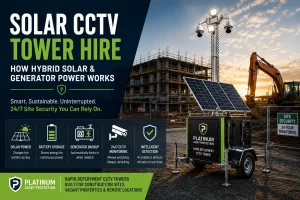
One of the defining advantages of a mobile CCTV tower is the ability to operate entirely independently of mains power. For remote construction sites, rural infrastructure projects, and temporary locations where connecting to the grid isn’t practical, autonomous power systems are what make continuous, uninterrupted surveillance possible.
Solar panels are the primary power source for most professional mobile towers. Mounted directly on the unit, they harvest energy throughout the day and feed it into onboard battery banks keeping cameras, connectivity, and monitoring systems running around the clock. Modern solar-powered units are capable of sustaining full operation through multiple days of limited sunlight, making them reliable even in overcast or winter conditions across the UK.
High-capacity battery banks act as a buffer, storing surplus solar energy and maintaining power during periods of low generation or high demand. A well-specified system will carry enough battery capacity to run continuously for several days without any solar input critical for sites where power interruption would create a security gap.
For deployments in particularly remote locations or during extended periods of poor weather, fuel cell systems provide an additional layer of power resilience. Hybrid configurations that combine solar, battery, and fuel cell technology ensure that surveillance solutions remain fully operational regardless of environmental conditions or the length of deployment.
The ability to operate without mains power removes one of the biggest barriers to deploying security on temporary or remote sites. There are no cable runs to plan, no connection costs, and no dependency on site infrastructure that may not yet exist or may already have been decommissioned.
The camera technology built into modern CCTV towers has advanced significantly beyond simple recording. Today’s professional units combine high-definition optics with intelligent video analytics shifting the role of mobile surveillance from passive recording to active, real-time threat detection.
Pan-tilt-zoom cameras remain the backbone of most mobile tower deployments. Their ability to pan across wide areas, tilt to adjust elevation, and zoom in on specific points of interest gives operators full situational awareness without needing multiple fixed units. Combined with HD resolution and infrared night vision, PTZ cameras deliver clear, usable footage in all lighting conditions.
Thermal cameras detect heat signatures rather than visible light, making them particularly effective in complete darkness, heavy rain, or foggy conditions where standard cameras struggle. For perimeter monitoring on large or remote sites, thermal imaging provides a level of detection reliability that HD cameras alone cannot match.
Artificial intelligence has transformed how incidents are identified. Rather than relying on motion detection which generates significant numbers of false alarms from environmental factors like wind, animals, or passing vehicles AI-powered analytics distinguish between genuine threats and irrelevant movement. The system learns to recognise people, vehicles, and specific behaviours, triggering alerts only when a real security event is detected.
Beyond basic detection, intelligent analytics can identify specific scenarios perimeter breaches, loitering, object removal, or unauthorised access to restricted zones. These capabilities allow security teams to respond to incidents as they develop rather than reviewing footage after the fact, dramatically improving both response times and incident prevention rates.
The true operational value of mobile surveillance towers is realised not just through the hardware on-site, but through the monitoring capability behind it. When cameras detect an incident, it’s the response infrastructure that determines whether a threat is deterred, contained, or simply recorded.
Live footage from mobile towers is transmitted via 4G or 5G connectivity to a dedicated monitoring centre staffed by trained security operators. Rather than waiting for footage to be reviewed after an incident, operators watch feeds in real time identifying suspicious behaviour as it develops and initiating a response before a situation escalates. Multiple sites can be monitored simultaneously from a single location, making remote monitoring a highly cost-effective alternative to on-site guarding.
One of the most effective deterrence tools available to remote operators is the integrated speaker system. When suspicious activity is detected, operators can issue a live voice-down a direct verbal warning broadcast from the tower itself instructing individuals to leave the site or cease their activity. In the majority of cases, an immediate, targeted voice-down is enough to stop an incident before it progresses further.
When a voice-down is insufficient or a serious incident is underway, monitoring centres follow structured escalation procedures. Automated alerts notify site managers and security contacts instantly, while operators coordinate directly with emergency services when required. This layered response structure ensures that no incident goes unmanaged regardless of the time of day.
Reliable connectivity is the backbone of any remote monitoring operation. Modern surveillance solutions utilise 4G and increasingly 5G networks to transmit high-definition footage with minimal latency ensuring operators receive a clear, real-time picture of events on-site. For sites in areas with limited signal, units can be configured with signal boosters or multi-network SIM capability to maintain a stable connection throughout the deployment.
For businesses weighing up their security options, a mobile CCTV tower offers a combination of capability, flexibility, and cost efficiency that fixed systems and traditional guarding simply can’t match. Whether you’re managing a long-term construction project or exploring mobile CCTV tower hire for a short-term requirement, these are the eight benefits that make mobile towers the preferred choice for site security across industries.
Prevention is always preferable to response and a site CCTV tower is one of the most effective deterrence tools available for high-risk locations. The visible presence of a professional surveillance unit communicates clearly to anyone approaching a site that they are being monitored, recorded, and that a response is ready to be triggered.
Opportunist criminals the majority of those responsible for site theft, vandalism, and trespassing make quick risk assessments before acting. A prominent tower with visible cameras, warning signage, and indicator lights signals that a site is actively protected. Research consistently shows that visible security measures are among the most effective deterrents against opportunist crime, and a tower elevated above the site perimeter is one of the hardest security assets to miss or ignore. In most cases, that visible deterrent alone is enough to make a site a less attractive target than an unmonitored alternative nearby.
Where a visible presence isn’t sufficient, integrated warning systems take deterrence a step further. Strobe lights, sirens, and live voice-down capability allow remote operators to intervene the moment suspicious behaviour is detected confronting individuals directly before they have the opportunity to cause damage or remove assets from the site.
There is a significant difference between a site with cameras and a site with actively monitored mobile surveillance. Criminals are increasingly aware that unmonitored cameras present little real risk footage may exist, but no one is watching in real time. A professionally monitored tower removes that assumption entirely. The combination of visible hardware, active monitoring, and immediate response capability creates a deterrence effect that passive recording systems cannot replicate.
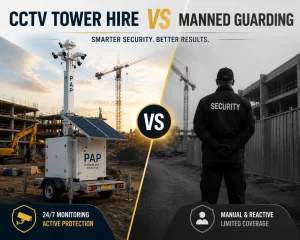
Traditional security guarding is expensive, resource-intensive, and increasingly difficult to scale across large or multi-site operations. Mobile CCTV tower hire offers a compelling alternative delivering equivalent or superior coverage at a significantly lower ongoing cost, without the operational complexity that comes with managing a guarding team.
The headline day rate of a security guard rarely reflects the full cost. Employers and contractors must account for shift patterns, overnight premiums, holiday and sickness cover, supervision, and the simple reality that a single guard can only physically be in one place at a time. Across a large construction site or multi-access infrastructure project, achieving meaningful coverage through guarding alone requires significant headcount and significant spend.
A single mobile tower elevated to full mast height can monitor an area that would require multiple guards to cover on foot. CCTV towers connected to a remote monitoring centre provide 24/7 coverage without shift changes, fatigue, or human error and unlike a guard, a tower with an integrated voice-down system can simultaneously deter an incident and alert emergency services while continuing to record evidential footage.
The cost advantage of mobile towers over guarding becomes most apparent on long-duration projects and large sites. Once a tower is deployed, the ongoing monitoring cost is fixed and predictable there are no overtime rates, no agency premiums, and no gaps in coverage caused by staffing shortages. For many site managers, a hybrid approach works best: mobile towers handling perimeter and wide-area coverage, with guarding resource concentrated on access control and high-value asset protection where a physical presence adds specific value.
A mobile CCTV tower does more than protect a site in the moment it builds a continuous, timestamped record of everything that happens on and around it. That record has significant value long after an incident has occurred, supporting investigations, validating insurance claims, and demonstrating compliance with site safety and security obligations.
Professional mobile towers record in high definition around the clock, ensuring footage captures sufficient detail to be of genuine use when it matters. Clear identification of individuals, vehicles, and events is critical for police investigations and legal proceedings low-resolution or poorly positioned cameras frequently produce footage that cannot be acted upon. HD recording from an elevated, well-positioned tower removes that risk.
Theft, vandalism, and damage claims are significantly easier to process and validate when timestamped footage clearly documents an incident from start to finish. Insurers increasingly expect evidence of active security measures on high-risk sites, and footage from mobile surveillance towers provides exactly that reducing both the likelihood of a disputed claim and the time taken to resolve one.
Authorised site managers and security personnel can access recorded footage remotely at any time via secure online portals or dedicated apps. This means incidents can be reviewed immediately without the need to visit the site or retrieve physical storage media accelerating response times and simplifying the handover of evidence to police or insurers.
Footage retention periods can be configured to meet specific project or regulatory requirements, ensuring records are available for as long as they are needed. For sites with compliance obligations infrastructure projects, regulated industries, or locations operating under specific planning conditions continuous recording provides a verifiable audit trail that supports reporting and demonstrates duty of care.
Few security solutions are genuinely built for every environment but a site CCTV tower comes as close as any. What makes mobile towers uniquely flexible isn’t just where they can be deployed, but how easily they adapt as operational needs change throughout a project’s lifecycle.
Unlike fixed systems that require significant effort and cost to move, a mobile tower can be repositioned within hours using standard vehicles no specialist contractors, no groundworks, no disruption to site activity. As a project moves through different phases, coverage moves with it. A tower protecting a materials compound at the start of a project can be repositioned to monitor a newly exposed perimeter section three months later, then moved again at project close without leaving any permanent footprint.
Operational requirements change and mobile towers scale with them. A single unit can provide adequate coverage for a compact site or early project phase, with additional units deployed as the site expands or risk levels increase. Equally, units can be consolidated or stood down as a project winds down, avoiding the cost of maintaining fixed infrastructure that is no longer needed.
For businesses managing security across several locations simultaneously, surveillance trailers can be distributed across sites and managed centrally through a single monitoring arrangement. Coverage can be rebalanced between sites as priorities shift redirecting units from a lower-risk location to one facing increased threat without the lead times or costs associated with new fixed installations. This operational flexibility makes mobile towers a particularly effective tool for contractors and security managers responsible for multiple active sites at any one time.
From inner-city developments to remote rural projects, mobile CCTV towers are deployed across a wider range of environments than any other temporary security solution. Whether you need a rapid deployment CCTV tower company for construction or a scalable system across multiple public sector sites, mobile towers provide the flexibility, speed, and reliability that fixed infrastructure simply cannot. Here are the ten most common use cases where these systems deliver the greatest impact.
Choosing between a mobile CCTV tower and a traditional fixed system isn’t simply a question of preference it’s a decision driven by the practical realities of the site, the duration of the project, and the level of flexibility required. For temporary, remote, or rapidly changing environments, the comparison rarely favours fixed infrastructure.
Traditional CCTV systems require significant upfront installation work cabling, mounting, power supply connections, and often groundworks. From survey to live operation, a fixed system can take days or weeks to become functional. CCTV towers, by contrast, are operational within hours of arrival. There is no installation phase, no contractor dependency, and no delay between deployment and live coverage.
Once a fixed system is installed, it stays where it is. If a site layout changes, a new risk area emerges, or the project moves to a different location, the infrastructure either becomes redundant or requires significant cost and effort to relocate. Mobile towers have no such limitation they can be repositioned overnight, redeployed to a new site entirely, or scaled up with additional units as requirements evolve.
Fixed cameras cover fixed angles. Mobile surveillance towers, elevated on telescopic masts and equipped with PTZ cameras, can monitor wide areas from a single position and be adjusted remotely to track movement or focus on specific zones. This combination of height, range, and directional control gives mobile towers a coverage advantage that fixed systems struggle to match on large or complex sites.
Fixed CCTV systems depend on site infrastructure mains power, network connectivity, and physical mounting points. When any part of that infrastructure fails or changes, the system is compromised. Mobile towers are self-contained, with autonomous power systems and built-in connectivity that operate independently of anything on-site. Maintenance is managed by the provider and does not depend on site conditions remaining stable.
Fixed CCTV remains the right choice for permanent premises with stable layouts and long-term security requirements retail environments, office buildings, and established facilities where infrastructure already exists and coverage requirements don’t change. For everything else temporary sites, remote locations, and projects where flexibility is non-negotiable mobile towers are the more practical, cost-effective, and operationally sound solution.
Selecting the right system for your site goes beyond comparing specifications it requires evaluating the provider as much as the product. The right mobile CCTV tower hire arrangement delivers not just hardware, but a complete security solution backed by reliable deployment, genuine monitoring capability, and responsive support throughout the contract.
Before signing with any provider, get clear answers to these:
Once you have confidence in the provider, focus on specification. Larger sites with multiple access points will require more than one unit a reputable provider will conduct a site survey and make recommendations based on actual coverage requirements rather than a generic package. For remote or off-grid sites, confirm exact battery runtime in your expected conditions, not just a headline figure. And for high false alarm environments, confirm whether AI-powered detection and thermal imaging are included and how they are configured for your specific site type.
Providers who cannot confirm deployment lead times in writing, hire packages that exclude monitoring without making this clearly visible, and suppliers with no third-party accreditation or evidence of compliance with BS EN 62676 the British Standard for CCTV surveillance systems should all give pause before committing.
A mobile CCTV tower delivers what fixed systems and traditional guarding cannot — immediate, flexible, monitored protection that adapts to your site from day one. Whether you are managing a long-term construction project, securing a vacant property, or responding to an urgent security requirement, mobile towers provide the coverage, reliability, and response capability that modern sites demand.
The combination of rapid deployment, autonomous power, and professional remote monitoring means your site is protected from the moment a tower arrives — no installation delays, no infrastructure dependencies, and no gaps in coverage as your project evolves. A rapid deployment CCTV tower removes the compromises that come with fixed infrastructure and puts security control back in the hands of the people who need it most.
For sites that cannot afford to wait, cannot commit to permanent infrastructure, or simply need surveillance solutions that scale alongside operational demands, mobile towers are the clear answer. The technology is proven, the deployment is fast, and the protection is continuous.
Get in touch today to discuss your site requirements, request a quote, or arrange a consultation with our security specialists. We’ll assess your site, recommend the right solution, and have coverage in place when you need it.
Most professional units can be delivered and operational within two to four hours of arriving on site. There is no specialist installation required once positioned and powered up, the tower is live and ready for monitoring immediately. For emergency situations, many providers offer same-day deployment depending on location and availability.
No. Mobile surveillance towers are designed to operate entirely off-grid using onboard solar panels and high-capacity battery banks. This makes them suitable for remote construction sites, rural locations, and any environment where mains power is unavailable or impractical. Hybrid systems combining solar, battery, and fuel cell technology provide additional resilience for extended or winter deployments.
Yes. Professional units are built with weatherproof, IP-rated housings that protect cameras, electronics, and power systems in rain, wind, and extreme temperatures. Towers are engineered to remain operational and stable in exposed environments throughout the duration of a deployment.
They can be. Many providers connect towers to professional monitoring centres staffed around the clock, with operators watching live feeds, issuing voice-down warnings, and escalating to emergency services when required. It is important to confirm monitoring arrangements with your provider, as some hire packages include remote monitoring while others provide hardware only.
Coverage range depends on mast height, camera specification, and site conditions. Most professional mobile CCTV tower units with PTZ cameras elevated to full mast height can effectively monitor an area of up to 500 metres in favourable conditions. For larger sites, multiple units deployed strategically will eliminate blind spots and deliver comprehensive coverage across the full perimeter.
Yes! relocation is one of the core advantages of mobile towers over fixed systems. Units can be repositioned as site layouts change, moved to a new location entirely, or redeployed across multiple sites as operational priorities shift. Most relocations can be completed within a few hours without specialist equipment.
Yes. Hire is the most common arrangement for temporary and project-based deployments, offering full flexibility without the capital commitment of purchasing. Hire packages typically include delivery, installation, maintenance, and optional remote monitoring. For businesses and contractors operating across mobile CCTV towers London and surrounding areas, short-term and long-term hire options are widely available to suit projects of any duration.
Footage is recorded and stored locally on the unit at all times, independent of connectivity. If a 4G or 5G connection is interrupted, recording continues unaffected and remote access is restored automatically once connectivity returns. This ensures there are no gaps in evidential footage regardless of network conditions.


Whether you need CCTV, manned guarding, mobile patrols, access control, or alarm response, our experienced team is here to help. Get expert advice and a free, no-obligation quote tailored to your security requirements.

We use cookies to improve your experience, analyse website traffic, and store preferences. You can accept or manage cookies anytime through your browser settings.
Manage your cookie preferences below:
Essential cookies enable basic functions and are necessary for the proper function of the website.
These cookies are needed for adding comments on this website.
Statistics cookies collect information anonymously. This information helps us understand how visitors use our website.
Google Analytics is a powerful tool that tracks and analyzes website traffic for informed marketing decisions.
Service URL: policies.google.com (opens in a new window)
Clarity is a web analytics service that tracks and reports website traffic.
Service URL: clarity.microsoft.com (opens in a new window)