Specialist Installers and Suppliers of
Monitored CCTV
A generator that runs dry at 2am and a camera that simply stops recording is the single biggest fear site managers raise about remote site security, and it is a fair one if the tower in question has no reserve power built in. If your site sits away from a mains connection, whether that is a rural compound, a quarry, or a solar farm build, a battery backup CCTV tower is the difference between continuous cover and a camera that goes dark the moment fuel or daylight runs short. This post explains how the power failover actually works, using our rapid deployment CCTV towers, alongside where thermal cameras and access control fit around a remote deployment.
Rural and greenfield sites across West Yorkshire, the Dales fringe, and areas around Wakefield and Wetherby often sit a long way from a mains connection, which rules out a fixed camera system that depends on grid power staying live. Insurers increasingly ask remote and unmanned sites to prove continuous coverage rather than daytime only monitoring, because theft and fly-tipping both spike overnight on sites with no visible deterrent. A remote construction site CCTV UK setup that relies purely on daylight solar charging leaves a real gap through short winter days, which is exactly the failure point a proper rapid deployment CCTV tower with reserve battery capacity is built to close.
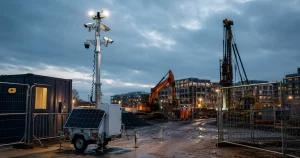
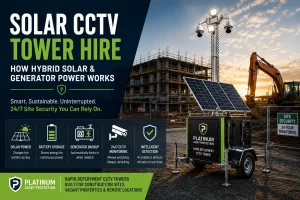
A rapid deployment CCTV tower runs on hybrid solar and generator power, with a battery bank sitting between the two that holds several days of reserve charge, so a run of overcast weather does not leave the unit exposed. It solves the problem of a purely solar unit running low through short daylight hours, because the generator only needs to fire when battery reserve drops below a set threshold, not constantly. Full detail on the unit build and charging setup is on our mobile CCTV tower explainer page.
Detection on the tower runs through Davantis, which analyses the live feed and raises an alert the instant someone crosses a defined perimeter line, rather than relying on stored footage being reviewed after the fact. It solves the problem of a remote site having no one physically watching the feed overnight, which is the whole reason a remote deployment needs detection rather than just recording. This layer sits behind every rapid deployment CCTV tower we install, and full detail on how detection and analytics work together is on our intelligent video analytics page.
Remote sites rarely have street lighting nearby, so a thermal camera solves a problem standard cameras cannot, reading a heat signature rather than relying on visible light, which removes both blind spots and false alarms from wildlife common on rural sites. This matters more on rural site security Yorkshire deployments than on urban compounds, because ambient light is often close to zero once the site generator winds down for the night. Full detail sits on our thermal security camera page and our thermal camera explainer.
Where a remote site still has a manned gate or compound entrance, pairing the tower with access control solves the problem of unrecorded entry, giving a proper log of who came on site rather than relying on memory after an incident.
For remote sites that still carry contractor risk, PPE compliance or lone working hazards, the Platinum Health and Safety Package uses Bi3 and IntelexVision to flag unsafe behaviour on camera, which is a separate concern to power and detection entirely. It sits as an optional add-on rather than something every remote deployment needs.
A site with short access gaps between visits needs less reserve capacity than a genuinely remote compound that might not see a refuel or check for a fortnight, and reserve capacity is the single biggest driver of spec on our rapid deployment CCTV towers.
A short-term rural project and a multi-month remote build have different cost profiles, and pricing on our rapid deployment CCTV towers comes down noticeably on longer hires.
Some remote sites only need overnight cover when the site is empty, others want 24/7 oversight because there is no fixed schedule for who is on site and when. Both options are available, and where a permanent solution suits the site better than a temporary tower, our bespoke fixed CCTV installation with 24/7 monitoring is worth comparing.
Because the tower runs on hybrid solar and generator power, most sites need zero groundworks, but access for a refuelling visit still affects the spec, a site down a long unmade track needs a bigger reserve buffer than one a van can reach easily.
Exposed hillside or moorland sites see faster battery drain in winter through both reduced daylight and increased heating load on the unit’s electronics, which our survey accounts for when sizing the mobile CCTV tower power system for that specific location.
A site further from our Morley base costs slightly more to service on a refuelling schedule, which is one reason a fixed quote before survey is never accurate for a genuinely remote deployment.
A standard fixed CCTV installation depends entirely on a live mains connection, which simply is not available on most rural, greenfield, or quarry sites, ruling it out before cost even enters the conversation. A rapid deployment CCTV tower with battery reserve removes that dependency completely, running on hybrid solar and generator power with several days of charge held in reserve.
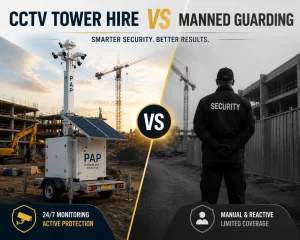
Where mains power genuinely is available, our bespoke fixed CCTV installation with 24/7 monitoring can offer a lower ongoing running cost over a long-term deployment, because there is no generator fuel to manage. The trade-off is flexibility, a fixed installation cannot be relocated as a site progresses through phases the way a tower can.
For sites carrying high value plant on unlit ground, a thermal security camera paired with battery backup closes a gap that mains-powered daylight cameras leave wide open overnight. Combined with Davantis detection, an alert reaches our monitoring centre and an audio challenge is issued the moment a heat signature crosses the perimeter line, regardless of whether the site has grid power at all. If you are weighing up a remote deployment against a mains-powered alternative, speak to our security specialists and we will give you a straight comparison for your site.
Assuming solar alone will cover a UK winter. Daylight hours drop sharply between November and February, and a solar-only unit without a proper battery reserve and generator failover simply cannot keep pace. A rapid deployment CCTV tower built on hybrid solar and generator power avoids this exact failure.
Not checking reserve capacity before committing to a remote site. A site visited fortnightly needs far more reserve than one checked daily, and getting this wrong means a camera going dark with nobody aware until the next visit. This is exactly what a proper site survey establishes before a mobile CCTV tower is specified.
Treating a remote site the same as an urban compound for lighting. Standard cameras rely on ambient light that simply is not there on rural or moorland sites after dark. A thermal security camera removes the false alarm and blind spot problem that darkness creates.
Skipping access control because “nobody comes here anyway”. Remote sites still see contractor visits, deliveries, and occasional unauthorised access, and without access control there is no record of who was on site if something does happen.
Assuming health and safety monitoring is included with security cover. It is not, the health and safety package using Bi3 and IntelexVision is a separate scope to Davantis detection, and conflating the two leads sites to under-specify one or the other.
Our process starts with a call where we establish site location, access for refuelling visits, and how long the compound sits unattended between checks, which determines the battery reserve capacity we specify on your rapid deployment CCTV tower. For genuinely remote sites this survey step matters more than on an urban compound, because getting reserve capacity wrong means a real gap in cover.
Once confirmed, the unit is delivered and configured with hybrid solar and generator power sized to your site’s access schedule, and Davantis detection zones are set to match your perimeter. Where ambient light is poor, we fit a thermal camera at the same visit rather than as a separate call out.
Our monitoring centre in Morley tests the live feed and detection zones before handover, and every alert from that point routes through our team rather than sitting unwatched on a local drive. Where a site also needs entry logging, we fit access control at the same visit, and where contractor safety compliance is the concern rather than theft, we scope the health and safety package separately. For sites sitting vacant between build phases, the same tower doubles as vacant property security cover without a separate contract.
A generator running dry overnight should never mean a camera going dark, and that reliability is the entire reason a battery backup CCTV tower exists as a proper specification rather than a marketing line. Our rapid deployment CCTV towers hold days of reserve charge on hybrid solar and generator power, backed by Davantis detection and, where a site needs it, a thermal camera for unlit rural ground. Pair that with access control at the gate and the health and safety package where compliance matters, and a remote compound goes from exposed to fully covered without ever needing a mains connection.
Cost depends on reserve capacity, hire duration, and access for refuelling, so we do not quote a flat number without a survey. What we can say is that pricing on our rapid deployment CCTV towers comes down on longer hires, and requesting a free quote gets you an accurate figure within a day.
Yes, our monitoring centre is based in Morley but our rapid deployment CCTV towers are deployed across the UK, including genuinely rural and off-route sites.
Our standard target is 48 hours from confirmed order to a live unit on site, though access on rural terrain can add time compared with a straightforward urban compound. Getting an accurate timeline is part of what the site survey establishes before we confirm a delivery date.
The battery bank on a rapid deployment CCTV tower is sized to hold several days of reserve charge specifically so a delayed refuelling visit does not leave the unit exposed, and our team tracks reserve levels remotely so a visit is scheduled before capacity runs critically low.
Yes, Davantis detection runs on the same hybrid solar and generator power system as the cameras, and an alert reaches our monitoring centre the same way whether the site has grid power or not. Full detail is on our intelligent video analytics page.
Yes, thermal cameras draw from the same reserve battery as the standard array, and are the better fit for remote sites with no ambient lighting after dark. Full detail on how thermal detection differs from standard cameras is on our thermal camera page and thermal explainer.
Whether you need CCTV, manned guarding, mobile patrols, access control, or alarm response, our experienced team is here to help. Get expert advice and a free, no-obligation quote tailored to your security requirements.

We use cookies to improve your experience, analyse website traffic, and store preferences. You can accept or manage cookies anytime through your browser settings.
Manage your cookie preferences below:
Essential cookies enable basic functions and are necessary for the proper function of the website.
These cookies are needed for adding comments on this website.
Statistics cookies collect information anonymously. This information helps us understand how visitors use our website.
Google Analytics is a powerful tool that tracks and analyzes website traffic for informed marketing decisions.
Service URL: policies.google.com (opens in a new window)
Clarity is a web analytics service that tracks and reports website traffic.
Service URL: clarity.microsoft.com (opens in a new window)