Specialist Installers and Suppliers of
Monitored CCTV
A construction site in Manchester can look secure during working hours and still be highly exposed overnight.
Open compounds, temporary fencing, changing access points, plant, fuel, copper cable, tools and unfinished buildings create a very different security challenge from a normal commercial property. The right construction site security company in Manchester should therefore provide more than cameras. It should be able to assess the site, identify vulnerable areas and build a security setup that can change as the project progresses.
Platinum Asset Protection provides construction site security across Manchester and the wider North West, with monitored CCTV, rapid-deployment towers and site-specific security planning.
So, what should you actually look for when comparing providers?
One of the biggest mistakes is choosing a security company based on a product list.
A tower with a camera on top does not automatically mean a site is secure.
A professional provider should first look at:
Construction sites change constantly. Hoarding moves, new buildings appear, materials are relocated and access routes change as different contractors arrive. PAP’s construction security approach specifically recognises that the security arrangement needs to change with the project rather than forcing the project around a fixed setup.
That makes a proper site survey one of the first things to ask about.
If your site is already active, waiting weeks for a permanent CCTV installation may leave a dangerous security gap.
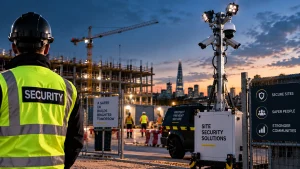
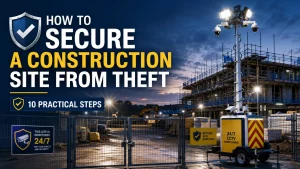
This is where a mobile CCTV tower or rapid deployment CCTV tower can be particularly useful.
These systems are designed to provide temporary surveillance where fixed infrastructure is not yet available, or where additional coverage is needed during a higher-risk phase of a project. PAP states that its rapid-deployment towers can be operational within 48 hours of survey approval, subject to site access and specification.
When comparing providers, ask whether the system is genuinely suitable for construction environments and whether it can be moved as your site develops.
Look for features such as trailer-mounted CCTV / skid-mounted chassis, a telescopic CCTV mast, multi-angle cameras and weather-resistant, tamper-resistant equipment.
The objective is simple: put reliable surveillance where the risk actually is.
For temporary or changing sites, see the CCTV tower hire and rapid deployment service.
More Posts

Basic CCTV records what happens.
A stronger system helps determine what is happening.
That distinction matters on a construction site.
A modern setup may use PTZ (Pan-Tilt-Zoom) cameras, intelligent video analytics or thermal technology to improve detection around perimeter areas and vulnerable zones.
For example, AI video analytics can be used to distinguish relevant objects and activity from some sources of nuisance alerts. PAP describes its intelligent video analytics as using object detection and automated monitoring to turn CCTV footage into live security intelligence.
For sites with difficult lighting or exposed perimeters, thermal cameras can also have a role. PAP’s thermal service is positioned for detection day or night and for areas where standard cameras may struggle.
That is why you should ask:
What happens when the system detects movement?
A good provider should be able to explain the full process from detection to verification and response.
A camera that records an intruder after the event is useful evidence.
A system that can challenge an intruder while they are still on site can be much more valuable.
Look for a 2-way audio challenge speaker or real-time audio voice-down intervention where appropriate.
PAP’s monitored CCTV systems can include live intervention from its in-house control room, while rapid-deployment tower systems can include integrated audio deterrence.
Visible deterrence can also include:
The principle is straightforward: make unauthorised access difficult, obvious and uncomfortable before it becomes theft or damage.
A security system is only useful while it is operating.
Construction sites do not always have reliable mains power, particularly during early groundworks or before permanent services are connected.
That is why zero-mains / off-grid power setup should be part of the conversation.
Depending on the deployment, you may come across:
PAP’s rapid deployment towers use hybrid solar and generator power, allowing temporary towers to operate without a mains connection.
This is particularly relevant for early-stage construction projects, remote compounds and locations where installing permanent power would add unnecessary delay or cost.
Do not simply ask whether a tower is “solar powered”. Ask how the system maintains operation overnight, during poor weather and when the site has no mains supply.
The camera can be excellent, but what happens when the connection fails?
For remote surveillance, the provider should be able to explain its connectivity arrangement and how footage and alerts are handled.
A 4G/5G cellular link can make sense where fixed broadband is unavailable, while local recording can provide another layer of resilience.
You may also want to ask about:
24/7 onboard NVR recording
and:
cloud video storage and retention
The key question is not simply whether footage exists. It is whether you can access reliable, time-stamped evidence when an incident occurs.
This is where many construction site security companies are not equal.
There is a major difference between:
CCTV recording
and
CCTV monitoring.
With recording-only CCTV, someone may discover the incident the next morning.
With professional monitoring, an alert can be reviewed while the event is taking place.
PAP provides managed CCTV with 24/7 monitoring through its own control room, with selected deployments receiving continuous oversight and verified response.
When evaluating a provider, ask:
Who actually monitors the cameras?
An Alarm Receiving Centre (ARC) should have a defined process for alarm verification, live intervention and escalation rather than simply generating automated notifications.
This is particularly valuable for unmanned site surveillance, where nobody is physically present overnight.
See the managed CCTV monitoring service
A construction site is rarely vulnerable in just one place.
The security setup should prioritise the assets criminals are actually likely to target.
Large machinery can be expensive, mobile and attractive to organised thieves. Camera placement should cover parking areas, access routes and vulnerable perimeter points.
Fuel, copper cable and stored materials can become high-priority targets, particularly when compounds are quiet.
High-value tools and portable equipment should not simply be left outside the camera’s field of view. Storage areas and access routes should form part of the surveillance plan.
Completed or temporarily unoccupied areas can need a different approach from a busy live construction zone.
PAP’s construction theft prevention approach specifically focuses on gates, perimeter lines, compounds, material storage areas and plant parking zones, with security reviewed as the project changes.
For projects where theft prevention is the main concern, the construction site theft prevention solution is particularly relevant.
Detection without a response process is only half a solution.
When comparing providers, ask what happens after an event is verified.
A properly planned response may involve:
detection → verification → audio intervention → escalation → emergency response
That process should be explained before the contract begins.
You should also understand what your provider means by visual alarm verification, what evidence is retained and how incidents are reported.
Claims around BS 8484 / NSI Gold monitoring, insurance compliance or LPS 1175 standards should also be checked carefully against the exact service and equipment being proposed. Do not assume that every CCTV tower or monitoring package carries every certification simply because those terms appear in a supplier’s marketing.
A cheaper system is not necessarily a cheaper security solution.
Compare the whole arrangement:
For example, PAP’s rapid-deployment CCTV service describes monitoring as included, with maintenance and faults covered under the hire arrangement and towers capable of being moved as required.
That can make a monitored tower a practical manned guard alternative for certain site applications, particularly where the objective is continuous surveillance without placing security personnel permanently on site.
The right comparison is therefore not:
“How much is the CCTV tower?”
It is:
“What level of protection am I getting for the total cost?”
Local knowledge matters, but it should not mean simply having an office address in Manchester.
Your provider should understand the reality of construction projects across places such as Greater Manchester, Salford Quays, Trafford Park and Manchester City Centre.
Different locations can bring different challenges around access, neighbouring properties, traffic, public exposure and site layout.
At the same time, you want a provider capable of supporting the project when the build moves or the developer operates across multiple regions.
PAP is headquartered in Morley, Leeds and states that it provides construction security across the North West, including Manchester, Liverpool, Preston and Bolton, with UK mainland coverage.
This may be the most important point of all.
A construction site’s security requirements in the groundworks phase may be very different from those during structural work, fit-out or handover.
A good security partner should therefore be able to review:
where the cameras are
what the cameras are covering
what assets are most vulnerable
where contractors are entering
where the perimeter has changed
whether additional monitoring is required
PAP explicitly frames construction security around changing site boundaries, access routes, compounds and project phases rather than a fixed one-size-fits-all arrangement.
There is no single package that fits every project, but a well-planned system may combine:
Mobile CCTV towers for temporary surveillance
PTZ cameras for flexible coverage
AI video analytics for intelligent detection
Thermal sensors for challenging perimeter areas
Off-grid power where mains infrastructure is unavailable
24/7 monitoring for unattended periods
Two-way audio for active deterrence
Local and/or cloud recording for evidence
Regular security reviews as the build progresses
The important thing is that these technologies should work together around the site’s actual risks rather than being added simply because they sound advanced.
Before signing a contract, ask the provider:
Have you completed a proper site survey?
Can the system operate without mains power?
Can CCTV towers be moved as the project changes?
Is the CCTV actively monitored 24/7?
Who verifies alarms?
Can operators intervene using audio?
How is footage stored and retained?
What happens when an incident is verified?
Who maintains the equipment if it develops a fault?
Can the system scale as the site’s risk increases?
Those questions will tell you far more than a brochure full of cameras and technical specifications.
A construction site in Manchester needs security that can keep pace with the build.
The strongest approach combines site assessment, temporary surveillance, intelligent detection, active deterrence, professional monitoring and a response process designed around the project’s changing risks.
PAP’s construction security service is built around this approach, combining managed CCTV, rapid-deployment coverage and in-house monitoring for construction environments across the UK.
Need security for a construction project in Manchester? Start with a site survey and identify the risks before choosing the equipment.
Enjoyed this article?
★ Add Platinum Asset Protection as a Preferred SourceWhether you need CCTV, manned guarding, mobile patrols, access control, or alarm response, our experienced team is here to help. Get expert advice and a free, no-obligation quote tailored to your security requirements.

We use cookies to improve your experience, analyse website traffic, and store preferences. You can accept or manage cookies anytime through your browser settings.
Manage your cookie preferences below:
Essential cookies enable basic functions and are necessary for the proper function of the website.
These cookies are needed for adding comments on this website.
Statistics cookies collect information anonymously. This information helps us understand how visitors use our website.
Google Analytics is a powerful tool that tracks and analyzes website traffic for informed marketing decisions.
Service URL: policies.google.com (opens in a new window)
Clarity is a web analytics service that tracks and reports website traffic.
Service URL: clarity.microsoft.com (opens in a new window)