Specialist Installers and Suppliers of
Monitored CCTV
Time lapse for construction sites means fixing a camera in one position and photographing the build at set intervals for the full length of the project. Played back, months of work become a film of a few minutes. Developers and contractors use it for three things: marketing the finished building, keeping stakeholders updated without site visits, and holding a dated record of what happened and when.
The marketing value is the part most teams underuse. A good construction time lapse is one of the few pieces of content that is genuinely unique to your project, and it can feed launch campaigns, social media, investor updates and award entries for months. The catch is that it has to be planned before groundworks start, because you cannot go back and film a stage that has already happened.
This guide covers how time lapse for construction sites works and how to plan it so the footage is ready to use when the marketing team needs it.
A construction time lapse camera is a weatherproof, long-running system mounted on a fixed point overlooking the site. It is not a consumer camera on a pole. It has to survive a British winter, run for the full length of the build and keep the same framing from the first excavation to the final landscaping.
The process usually follows five steps:
During the project, recent images can usually be viewed online, so progress can be checked or shared without anyone travelling to site.
Most construction marketing relies on CGIs before completion and photography after. Time lapse fills the gap in between, and it does something neither can: it shows the building actually being made.
That makes it useful across almost every stage of a campaign:
The most common mistake is treating time lapse as an afterthought, something to edit once the building is finished. By then, the decisions that shape the final film have already been made.
Before installation, agree these points between the project team and whoever handles marketing:
Is the film about the scale of the structure, the speed of delivery, a dramatic transformation of a derelict site, or the community the building will serve? The answer affects where the camera goes.
A high vantage point that captures the full footprint usually beats a sharper camera with a partial view. Think about how the finished building will look from that position, not just the groundworks.
Steel frame up, topping out, cladding complete and handover are natural chapters for both the film and your social calendar. Knowing them in advance lets you plan content around them.
A 60-second social clip, a three-minute website film and a looping screen at a sales suite all need different edits. Planning the outputs early means the right footage is ready on time.
Most brands want to control pacing, music and branding themselves. Agree early whether your in-house team, an agency or a freelance editor will produce the final film.
This is where working with an experienced digital marketing consultant can make a real difference. A consultant can map the build milestones onto a content calendar, decide which channels each clip suits, and make sure the footage supports wider campaign goals rather than sitting unused on a hard drive.
The same footage that powers your marketing also gives you a permanent visual record of the build. That record supports progress reporting, helps answer questions about when particular work was carried out, and can be useful at handover or if a dispute arises.
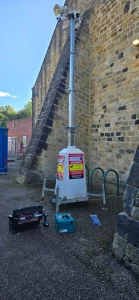
Platinum Asset Protection is a UK site security company providing timelapse camera hire for construction projects across the UK mainland from Morley, Leeds. Cameras are installed, maintained and repositioned by our own engineers for the length of the project, and you receive the complete image sequence at handover. Systems can be mounted on the same infrastructure as our rapid deployment CCTV towers, so they need no fixed power or internet connection.
Book a free site survey or call 0800 334 5687 to have your camera recording before groundworks begin.
Enjoyed this article?
★ Add Platinum Asset Protection as a Preferred SourceProfessional systems are specified to run unattended for the full length of a build, which can be months or years, with power, connectivity and weatherproofing chosen for the project duration.
No. Systems can be supplied with their own power and connectivity, which is important on sites that have neither in the early stages.
Yes. Cameras can be repositioned if the site layout changes or a new view is needed.
Typically the complete image sequence and footage in a standard format, ready for your editor, agency or marketing team to produce the final film.
No. Smaller developments, fit-outs and refurbishments also benefit, particularly where the finished result is part of a sales or marketing campaign.


Whether you need CCTV, manned guarding, mobile patrols, access control, or alarm response, our experienced team is here to help. Get expert advice and a free, no-obligation quote tailored to your security requirements.

We use cookies to improve your experience, analyse website traffic, and store preferences. You can accept or manage cookies anytime through your browser settings.
Manage your cookie preferences below:
Essential cookies enable basic functions and are necessary for the proper function of the website.
These cookies are needed for adding comments on this website.
Statistics cookies collect information anonymously. This information helps us understand how visitors use our website.
Google Analytics is a powerful tool that tracks and analyzes website traffic for informed marketing decisions.
Service URL: policies.google.com (opens in a new window)
Clarity is a web analytics service that tracks and reports website traffic.
Service URL: clarity.microsoft.com (opens in a new window)